
How to get back to growth?
How big of a problem inequality really is

Two weeks ago I had the pleasure to listen to a lecture by Christine Lagarde, Managing Director of the International Monetary Fund (IMF), at Kellogg School of Management in Evanston/Chicago. The event was part of her preparation journey to the 2016 Annual Meetings of the IMF and the World Bank in Washington D.C. Hence, it was not surprising that the topics of her talk were reflecting the agenda of that event (and that her statements were mostly politically balanced).
However, it is remarkable that the IMF and the World Bank managed to get their members countries to agree that inequality is the major threat to the global economy. As Madame Lagarde said in her speech at Kellogg: "Too little growth has benefitted too few people for too long".
Inequality is difficult to measure. The GINI coefficient, the most widely accepted metric of inequality, is a complex calculation and far from ideal. Only looking at this metric, Azerbaijan would be leading the global ranking, ahead of Ukraine, Slovenia, and Norway. It's hard to imagine a country, that's been ruled by the Aliyev clan for 30 years to be more "equal" than Norway (for those interested, the reason for these statistics, as stated in this paper, are non-exhaustive data gathering and transfer payments).
Furthermore, inequality is different if one looks at distribution of wealth, income, or consumption. Allocation of wealth is generally more unequal than that of consumption. But as I have stated in previous comments and without consulting scientific data, it seems that the perception of inequality in many countries has led to significant political shifts. And that is the most important metric. Whether the GINI coefficient is high or low, as long as a society beliefs that policies and structural changes are moving toward the better, the political support of such changes is likely to be high.
The economic facts suggest that the benefits of free trade, economic collaboration, and regulatory coordination are overall positive. For economists it is hard to see how those facts could be negated. But for the people who do not benefit from the economic growth the data suggests, it is even harder to understand where does figures come from.
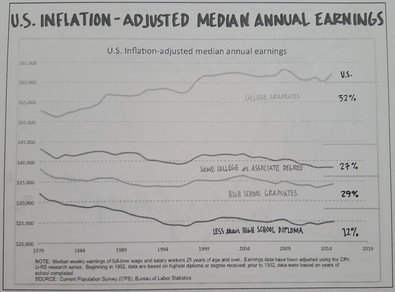
Graphic credit to Prof. Rebelo, an incredible source of wisdom for all things related to global finance
An example I recently came across is the median annual earnings of groups with different levels of education in the US. It is shocking to see that the real-income (inflation adjusted) of 68% of the working population (> 25 years) has decreased over the past 35 years. This is despite the US GDP per capita growing at an average of 1.6% per year over the same period (again, inflation adjusted). These 68% of people have de facto less in their pockets from month to month despite their economy doing better. The social tension this creates is now visible in the political landscape - on both sides of the aisle, as the Americans would say. And it is not only a problem in the US, I just happen to have compelling data to illustrate it. It seems that past economic growth to some extent masked the issue of inequality in developed economies.
The IMF identifying inequality as the biggest threat to global economic development shows that this message has also reached the political bureaucracy. A redistribution, rebalancing, and greater inclusiveness is needed. The dilemma is, that such redistribution is difficult in a low growth environment - after all, money talks. And, at this point, a lot of political capital is required to promote the economic policies needed to allow for growth (continuing free trade and global economic collaboration).
_____________________________________________
Please share your comments and inputs (via comment function, twitter, e-mail, etc.). In my short write-ups I address topics that I am particularly interested in because they align with my values and beliefs. As such, they are always a reflection of my ideas, thoughts, and opinions. The only thing I am positive in that regard is that I do not have all the perspectives, all the knowledge, or all the facts - help me be better tomorrow.
